when blood glucose levels fall what is the primary source of glucose to replenish the level
Regulation of glucose in the torso is washed autonomically and constantly throughout each minute of the solar day. Normal BG levels should be between sixty and 140 mg/dL in order to supply cells of the body with its required energy. Brain cells don't require insulin to drive glucose into neurons; however, in that location must still be normal amounts available. Too lilliputian glucose, chosen hypoglycemia, starves cells, and too much glucose (hyperglycemia) creates a sticky, paralyzing upshot on cells. Euglycemia, or claret sugar within the normal range, is naturally ideal for the body's functions. A fragile balance between hormones of the pancreas, intestines, brain, and even adrenals is required to maintain normal BG levels.
Fuels of the Torso
To appreciate the pathology of diabetes, it is important to understand how the trunk normally uses food for energy. Glucose, fats, and proteins are the foods that fuel the body. Knowing how the pancreatic, digestive, and abdominal hormones are involved in food metabolism tin help y'all understand normal physiology and how issues develop with diabetes.
Throughout the body, cells use glucose as a source of immediate energy. To go on the torso running smoothly, a continuous concentration of threescore to 100 mg/dL of glucose in blood plasma is needed. During exercise or stress the body needs a college concentration considering muscles require glucose for energy (Basu et al., 2009). Of the three fuels for the body, glucose is preferred considering it produces both energy and water through the Krebs cycle and aerobic metabolism. The body can also use protein and fat; nonetheless, their breakdown creates ketoacids, making the body acidic, which is not its optimal state. Backlog of ketoacids tin can produce metabolic acidosis.
Functioning trunk tissues continuously absorb glucose from the bloodstream. For people who exercise non accept diabetes, a meal of carbohydrates replenishes the circulating blood glucose nearly ten minutes subsequently eating and continues until nigh two hours after eating. A first-phase release of insulin occurs most 5 minutes afterwards a meal and a second phase begins at about 20 minutes. Because the duration of insulin's effect is only virtually 2 hours, taking a 2-hour postprandial (afterward meal) BG shows how well insulin was released and used by the body. The nutrient is broken downward into pocket-sized components including glucose and is then absorbed through the intestines into the bloodstream. Glucose (potential energy) that is not immediately used is stored by the trunk as glycogen in the muscles, liver, and fatty.
Your body is designed to survive and then it stores free energy efficiently, as fat. Almost Americans take backlog fatty considering they replenish the glucose stores by eating before whatever fat needs to be broken down.
When blood glucose levels fall after 2 hours, the liver replenishes the circulating blood glucose by releasing glycogen (stored glucose). Glycogen is a polysaccharide, made and stored primarily in the cells of the liver. Glycogen provides an free energy reserve that tin exist quickly mobilized to meet a sudden need for glucose.
Hormones of the Pancreas
Regulation of blood glucose is largely done through the endocrine hormones of the pancreas, a beautiful balance of hormones achieved through a negative feedback loop. The main hormones of the pancreas that affect blood glucose include insulin, glucagon, somatostatin, and amylin.
Insulin (formed in pancreatic beta cells) lowers BG levels, whereas glucagon (from pancreatic alpha cells) elevates BG levels.
Somatostatin is formed in the delta cells of the pancreas and acts as the "pancreatic policeman," balancing insulin and glucagon. It helps the pancreas alternate in turning on or turning off each opposing hormone.
Amylin is a hormone, fabricated in a 1:100 ratio with insulin, that helps increase satiety, or satisfaction and state of fullness from a meal, to forestall overeating. It also helps slow the stomach contents from elimination as well chop-chop, to avoid a quick spike in BG levels.
As a meal containing carbohydrates is eaten and digested, BG levels rise, and the pancreas turns on insulin product and turns off glucagon product. Glucose from the bloodstream enters liver cells, stimulating the action of several enzymes that convert the glucose to bondage of glycogen—so long as both insulin and glucose remain plentiful. In this postprandial or "fed" land, the liver takes in more glucose from the blood than it releases. After a repast has been digested and BG levels begin to fall, insulin secretion drops and glycogen synthesis stops. When it is needed for energy, the liver breaks down glycogen and converts it to glucose for easy transport through the bloodstream to the cells of the body (Wikipedia, 2012a).
In a healthy liver, up to 10% of its total volume is used for glycogen stores. Skeletal muscle cells store virtually ane% of glycogen. The liver converts glycogen back to glucose when it is needed for energy and regulates the amount of glucose circulating between meals. Your liver is astonishing in that it knows how much to store and keep, or suspension down and release, to maintain ideal plasma glucose levels. False of this process is the goal of insulin therapy when glucose levels are managed externally. Basal–bolus dosing is used as clinicians attempt to replicate this normal cycle.
While a good for you body requires a minimum concentration of circulating glucose (60–100 mg/dl), high chronic concentrations cause health problems and are toxic:
- Acutely: Hyperglycemia of >300 mg/dl causes polyuria, resulting in dehydration. Profound hyperglycemia (>500 mg/dl) leads to confusion, cerebral edema, coma, and, eventually, death (Ferrante, 2007).
- Chronically: Hyperglycemia that averages more than 120 to 130 mg/dl gradually damages tissues throughout the trunk and makes a person more than susceptible to infections. The glucose becomes syrupy in the bloodstream, intoxicating cells and competing with life-giving oxygen.
The concentration of glucose in the claret is determined by the residue between the rate of glucose entering and the charge per unit of glucose leaving the circulation. These signals are delivered throughout the body past 2 pancreatic hormones, insulin and glucagon (Maitra, 2009). Optimal health requires that:
- When blood glucose concentrations are low, the liver is signaled to add glucose to the circulation.
- When blood glucose concentrations are loftier, the liver and the skeletal muscles are signaled to remove glucose from the circulation.
Test Your Knowledge
Glycogen is:
- A hormone produced in the pancreas.
- A polysaccharide that is stored in the liver.
- Produced in the striated muscles when exercising.
- An energy reserve that is slow to mobilize in an emergency.
Apply Your Knowledge
If you want to lose weight, what fuel would you lot decrease in your diet and what fuels would you increment?
Online Resource
Video [2:36]
https://www.youtube.com/watch?five=OlHez8gwMgw
Answer: B
The Role of Insulin
Insulin is a peptide hormone made in the beta cells of the pancreas that is primal to regulating carbohydrate metabolism in the body (Wikipedia, 2016). After a meal, insulin is secreted into the bloodstream. When it reaches insulin-sensitive cells—liver cells, fat cells, and striated muscle—insulin stimulates them to accept up and metabolize glucose. Insulin synthesis and release from beta cells is stimulated by ascent concentrations of blood glucose. Insulin has a range of effects that tin can be categorized equally anabolic, or growth-promoting.
| Functions of Insulin | |
|---|---|
| Turns on | Turns off |
| Uptake and use of glucose by insulin-sensitive cells | Breakdown of glycogen in liver cells |
| Storage of glucose in the form of glycogen in the liver and skeletal muscle tissue. Storage of fat. | Breakup of fatty |
| Uptake of amino acids and the synthesis of proteins | Breakdown of protein |
| DNA synthesis | Gluconeogenesis |
Exam Your Noesis
Insulin:
- Is only available by injection or orally to treat T2DM.
- Is a hormone that acts on the liver to convert backlog glucose into glycogen.
- Inhibits the uptake and use of glucose by skeletal muscles.
- Is manufactured and secreted by the alpha cells of the pancreas.
Apply Your Cognition
How would yous explicate the part of insulin to your patient with diabetes? What does it plough on and what does it plow off?
Answer: B
The Part of Glucagon
Glucagon, a peptide hormone secreted by the pancreas, raises blood glucose levels. Its consequence is contrary to insulin, which lowers blood glucose levels. When it reaches the liver, glucagon stimulates glycolysis, the breakup of glycogen, and the export of glucose into the circulation. In these ways, the effects of glucagon are catabolic, breaking down cells—the contrary of insulin'southward anabolic effects (Drucker, 2008).
The pancreas releases glucagon when glucose levels fall too low. Glucagon causes the liver to convert stored glycogen into glucose, which is released into the bloodstream. High BG levels stimulate the release of insulin. Insulin allows glucose to be taken up and used by insulin-dependent tissues, such as muscle cells. Glucagon and insulin work together automatically as a negative feedback system to keeps BG levels stable.
Glucagon is a powerful regulator of BG levels, and glucagon injections can exist used to correct severe hypoglycemia. Glucose taken orally or parenterally tin can drag plasma glucose levels within minutes, but exogenous glucagon injections are not glucose; a glucagon injection takes approximately ten to twenty minutes to exist captivated by muscle cells into the bloodstream and circulated to the liver, there to trigger the breakdown of stored glycogen.
People with blazon 2 diabetes accept backlog glucagon secretion, which is a contributor to the chronic hyperglycemia of type 2 diabetes. The amazing residual of these two opposing hormones of glucagon and insulin is maintained by another pancreatic hormone called somatostatin, created in the delta cells. Information technology truly is the great pancreatic policeman as it works to keep them counterbalanced.
Complementary Roles of Insulin and Glucagon
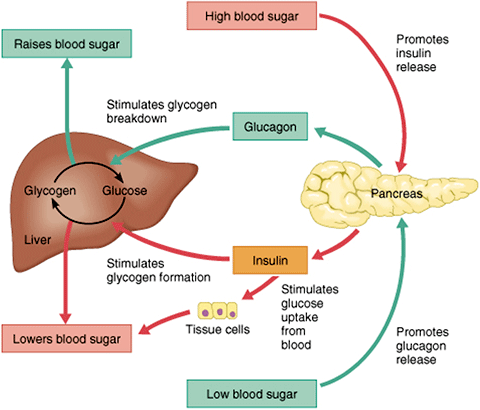
After you've eaten, the concentration of glucose in your blood rises. When information technology goes too high the pancreas releases insulin into the bloodstream. This insulin stimulates the liver to convert the blood glucose into glycogen for storage. If the blood sugar goes too low, the pancreas release glucagon, which causes the liver to plow stored glycogen back into glucose and release it into the blood. Source: Google Images.
Test Your Knowledge
Glucagon:
- Is a peptide hormone that is stored in the pancreas.
- Is used to care for hyperglycemia by increasing the uptake of glucose in muscles.
- Is a hormone that acts on the liver to catechumen glycogen back into glucose.
- Stimulates the production of insulin.
Apply Your Knowledge
How is glucagon bachelor by injection?
Reply: C
The Role of Amylin
Amylin is a peptide hormone that is secreted with insulin from the beta cells of the pancreas in a 1:100 ratio. Amylin inhibits glucagon secretion and therefore helps lower BG levels. It also delays gastric elimination afterwards a meal to decrease a sudden fasten in plasma BG levels; farther, it increases brain satiety (satisfaction) to aid someone feel full after a meal. This is a powerful hormone in what has been called the brain–meal connexion.
People with blazon 1 diabetes have neither insulin nor amylin product. People with type ii diabetes seem to make adequate amounts of amylin just often have problems with the abdominal incretin hormones that also regulate BG and satiety, causing them to feel hungry constantly. Amylin analogues accept been created and are available through various pharmaceutical companies every bit a solution for disorders of this hormone.
The Part of Incretins
Incretins are glucagon-like peptides (hormones) made in cells of the pocket-sized intestine and secreted into the apportionment in response to food intake (Cernea & Raz, 2011). Incretins become to work even before blood glucose levels ascent post-obit a meal. They as well slow the rate of assimilation of nutrients into the bloodstream past reducing gastric elimination, and they may besides aid decrease food intake by increasing satiety.
People with type ii diabetes take lower than normal levels of incretins, which may partly explicate why many people with diabetes state they constantly feel hungry. After inquiry showed that BG levels are influenced by intestinal hormones in addition to insulin and glucagon, incretin mimetics became a new grade of medications to help residual BG levels in people who accept diabetes.
Two types of incretin hormones are GLP-1 (glucagon-like peptide) and GIP (gastric inhibitory polypeptide). Each peptide is cleaved downwards past naturally occurring enzymes called DDP-four, (dipeptidyl peptidase-4).
Exenatide (Byetta), an injectable anti-diabetes drug, is categorized as a glucagon-like peptide (GLP-1) and directly mimics the glucose-lowering effects of natural incretins upon oral ingestion of carbohydrates. The administration of exenatide helps to reduce BG levels by mimicking the incretins. Both long- and short-acting forms of GLP-1 agents are currently beingness used.
The functions of incretins are as follows:
- Stimulate insulin secretion
- Suppress glucagon secretion
- Wearisome gastric emptying to forestall spike in BG levels
- Increase satiety after a repast to signal to the brain to cease eating
Incretins are deactivated quickly past enzymes chosen DPP-4, in the bloodstream and on the surface of endothelial cells; thus, the glucose-lowering effects of incretins last simply a few minutes (Drucker & Nauck, 2006). A new class of medications, chosen DPP4 inhibitors, block this enzyme from breaking down incretins, thereby prolonging the positive incretin effects of glucose suppression. An additional class of medications called dipeptidyl peptidase-4 (DPP-4 inhibitors—notation hyphen), are available in the form of several orally administered products. These agents volition be discussed more fully later.
Incretins Stimulate Insulin Release
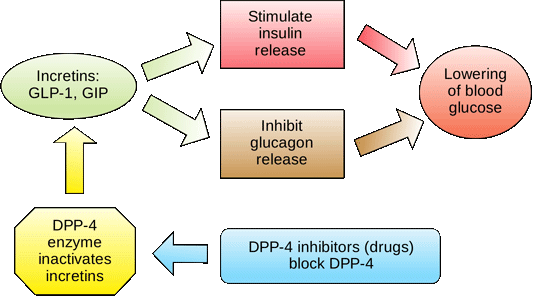
Source: Wikimedia Eatables.
Poor Regulation of Blood Glucose
People with diabetes take frequent and persistent hyperglycemia, which is the hallmark sign of diabetes. For people with type 1 diabetes, who make no insulin, glucose remains in the blood plasma without the needed BG-lowering effect of insulin. Another correspondent to this chronic hyperglycemia is the liver. When a person with diabetes is fasting, the liver secretes too much glucose, and it continues to secrete glucose even after the blood level reaches a normal range (Basu et al., 2009).
Some other correspondent to chronic hyperglycemia in diabetes is skeletal musculus. Later a meal, the muscles in a person with diabetes take up too trivial glucose, leaving claret glucose levels elevated for extended periods (Basu et al., 2009).
The metabolic malfunctioning of the liver and skeletal muscles in type two diabetes results from a combination of insulin resistance, beta cell dysfunction, backlog glucagon, and decreased incretins. These problems develop progressively.
Early in the affliction the existing insulin resistance can be counteracted past excess insulin secretion from the beta cells of the pancreas, which try to address the hyperglycemia. The hyperglycemia caused by insulin resistance is met past hyperinsulinemia. Eventually, however, the beta cells begin to neglect. Hyperglycemia can no longer be matched by excess insulin secretion, and the person develops clinical diabetes (Maitra, 2009).
Examination Your Knowledge
People with blazon two diabetes have:
- Insulin sensitivity, which is an over-reaction of cells to insulin.
- No beta cells in their pancreas and no circulating insulin at all.
- Chronic hypoglycemia.
- Insulin resistance, which is a decreased response of cells to insulin.
Apply Your Knowledge
How would y'all explain to your patient what lifestyle behaviors create insulin resistance?
Answer: D
The Problem of Insulin Resistance
In type 2 diabetes, many patients take trunk cells with a decreased response to insulin known as insulin resistance. This means that, for the same amount of circulating insulin, the skeletal muscles, liver, and adipose tissue have upward and metabolize less glucose than normal. Beingness less sensitive to insulin, the liver does not react to the usual betoken of insulin, so the liver manufactures and secretes more glucose than is needed (Huether & McCance, 2012).
Insulin resistance can develop in a person over many years before the appearance of blazon 2 diabetes. People inherit a propensity for developing insulin resistance, and other wellness problems can worsen the condition. For instance, when skeletal muscle cells are bathed in backlog complimentary fat acids, the cells preferentially use the fat for metabolism while taking up and using less glucose than normal, even when at that place is plenty of insulin bachelor. In this mode, high levels of claret lipids decrease the effectiveness of insulin; thus, loftier cholesterol and body fat, overweight and obesity increment insulin resistance.
Physical inactivity has a similar effect. Sedentary overweight and obese people accumulate triglycerides in their musculus cells. This causes the cells to use fat rather than glucose to produce muscular energy. Physical inactivity and obesity increase insulin resistance (Monnier et al., 2009).
The Problem of Beta Cell Dysfunction
For people with type 1 diabetes, no insulin is produced due to beta cells destruction. Enquiry shows this is an autoimmune response gone awry, attacking the body'south ain cells. Triggers of that autoimmune response take been linked to milk, vaccines, environmental triggers, viruses, and leaner.
For people with type 2 diabetes, a progressive decrease in the concentration of insulin in the blood develops. The continuously decreasing availability of insulin in blazon 2 diabetes is the directly result of a progressive worsening of the beta cells' power to produce enough insulin when it is needed (Huether & McCance, 2012).
Not just do the beta cells release less insulin as type 2 diabetes progresses, they also release it slowly and in a different design than that of healthy people (Monnier et al., 2009). Without sufficient insulin, the glucose-absorbing tissues—mainly skeletal musculus, liver, and adipose tissue—practice non efficiently clear excess glucose from the bloodstream, and the person suffers the damaging effects of toxic chronic hyperglycemia.
At get-go, the beta cells manage to manufacture and release sufficient insulin to compensate for the higher demands caused by insulin resistance. Eventually, all the same, the lacking beta cells decrease their insulin product and can no longer meet the increased demand. At this point, the person has persistent hyperglycemia. In type ii diabetes, beta cells seemingly frazzle their capacity to adapt to the long-term demands of peripheral insulin resistance (Huether & McCance, 2012).
A down screw follows. The hyperglycemia and hyperinsulinemia acquired by the over-stressed beta cells create their own failure. In type ii diabetes, the continual loss of functioning beta cells shows up as a progressive hyperglycemia.
Examination Your Knowledge
In type ii diabetes:
- Beta cells in the pancreas cannot recoup for insulin resistance.
- The pancreas is attacked past the body'southward immune system, resulting in pancreatitis.
- The liver becomes overly sensitive to insulin.
- Glucose cannot exist used as fuel past whatsoever cells in the body.
Apply Your Noesis
How would you explain insulin resistance differently to someone with type i diabetes and someone with type 2 diabetes?
Online Resources
Video [11:46]
https://www.youtube.com/watch?v=iTjDi2ZO0n8
Answer: A
Cell Harm in DM
Together, insulin resistance and decreased insulin secretion lead to hyperglycemia, which causes most of the health problems in diabetes. The acute wellness problems—diabetic ketoacidosis and hyperosmolar hyperglycemic country—are metabolic disorders that are direct acquired by an overload of glucose. In comparing, the chronic health problems—eye, heart, kidney, nerve, and wound issues—are tissue injury, a slow and progressive cellular damage caused by feeding tissues too much glucose (ADA, 2015).
Hyperglycemic damage to tissues is the outcome of glucose toxicity. There are at least 3 distinct routes by which excess glucose injures tissues:
- Over time, excess glucose attaches to proteins in a procedure chosen glycosylation. For example, glycosylated hemoglobin (HbA1c), is the laboratory measure to monitor boilerplate glycemic levels. Glycosylated proteins trigger inflammatory reactions, which injure the lining of blood vessels. In addition, glycosylated proteins stick together on the basement membranes of capillaries, thickening the endothelial layers and disrupting their normal role.
- Backlog intracellular glucose activates an enzyme chosen protein kinase C, which encourages the growth of unnecessary blood vessels, leads to blood vessel constriction, thickens basement membranes, and releases pro-inflammatory molecules such as C-reactive protein and homocysteine.
- Excess intracellular glucose reduces the effectiveness of the intracellular activities that protect confronting oxidants and oxidative stress. This leads to oxidative damage, particularly in neurons. (Maitra, 2009)
Source: https://www.atrainceu.com/content/4-regulation-blood-glucose
0 Response to "when blood glucose levels fall what is the primary source of glucose to replenish the level"
Post a Comment